NOTE: It's recently come to my attention that I get traffic from all over (29 countries and counting). Many stumble here off Google searches for information about Korea. An example that sticks out is a fellow that now teaches here in Daegu that randomly found this blog and recognized me by chance at a bar downtown.
I decided to put together an overview of what it's like to teach English in Korea. It's a lot of things I wondered before I came and would like to share with others that are considering. I should say that it's intended to prompt questions rather than be an exhaustive source of information.
Personally, I arrived here without a clear understanding of what I was in for. I knew it at the time, and there wasn't that much I could do because I think that one's experience is shaped largely by the particulars of one's school (students, co-workers, schedule) and the city/area you live in.
In general, the English teaching scene here can be divided into two camps: public school positions and private academy (hagwon) positions. My experience and knowledge is in a hagwon, so I have more to say about that. There are important differences between the two.
From my understanding, public school jobs can be competitive, as opportunities only come up twice a year in September and February. The working hours are usually less and salaries slightly lower (I think around $100-$200 a month less). You spend less time in the classroom, but you also spend more time preparing lesson plans. Another difference is the schedule time. You head in at 8:30 and leave at 4:30, whereas hagwons are early afternoons to evenings/nights ( my schedule is 1-9 and I don't really start teaching until 3:30).
I began looking for positions in September, of course well after the deadlines from public school positions beginning that month. I had no interest in waiting around until practically March.
FINDING A HAGWON
At that time, I was in contact with a number of recruiting agencies that I found through contacts and sites like Dave's ESL cafe. I highly recommend browsing Dave's, I learned a lot and I'm repeating some general information that you can find there in more detail. I would advise you to read the negative posts on the message boards with reason and some skepticism. They seem to be jammed disproportionately with posts from very bitter and resentful people that had bad experiences.
I've met many teachers here in Daegu and others from cities like Seoul, Busan, Daejon, and Ulsan and I've not heard many stories of lost diplomas, hagwons going out of business, withholding of pay, and denial of airfare. I had a recruiter whose company specialized in public school positions give me a 15-minute lecture over the phone that I think was designed to scare me out of ever wanting to work at a hagwon. If I hadn't been so put off by his condescending tone, it might have worked.
To be sure, these things do happen and there are bad schools out there, but if you're patient and smart in the job search process, you shouldn't have a problem. If something doesn't feel right, it's advisable to move on, because even in these economic times, there are a lot of opportunities. There are so many recruiters out there that can round up jobs particular to your requests, you shouldn't feel obligated to take any particular offers.
IS THIS WHAT YOU WANT TO DO?
About a month ago, a new teacher from a small, rural part of the U.S. arrived at the hagwon next door to mine. On his first day, I heard he was rude to students and other teachers, and the next day, he didn't show up. He was fired then and there. I have sympathy for how things turned out. It obviously wasn't a good decision for him to come. Undoubtedly, he has nothing good to say about the school or Korea, and I wouldn't be surprised if he posted on Dave's about it.
Open mindedness and flexibility are the most important things to come to Korea with or to work in any foreign country. Even with a terrific attitude, the beginning is really tough. It's wise to ask yourself if you can mentally get through the stress of adjusting. I had some bad days during my first month, but everyone deals with it differently.
LOCATION
My only request to my recruiters was to end up in a major city, not necessarily Seoul. I wanted that urban environment with lots of people and places to see, but with more individual character than you tend to find in enormously sprawling international cities. I ended up in Daegu, and I'm thrilled with my luck (I say luck because I knew very little about Daegu before I got here). The expat community has been great in helping the adjustment process and not feeling like a lonely Westerner stranded on an island in an Eastern sea.
I didn't expect to find so many foreigners in Daegu and after being here awhile, I've learned that there are also many expats in places like Busan, Ulsan, and Daejon. For anyone coming to Korea for the first time, especially if you've never lived independently outside your home country for an extended period of time, I recommend looking to be in one of the larger cities. Even here in Daegu, because of my schedule, and where I live, I rarely see friends Monday-Friday and can feel isolated, albeit for short periods of time.
Having other English speakers around to share stories and thoughts is therapeutic. Even the most adaptable people meet frustrations and anxieties and it's healthy to vent these and hear other people are experiencing the same things.
SALARY AND BENEFITS
I think Korea has to be the best country in the world for first-time teachers. With little qualification (essentially a bachelor's degree in anything), you can land a position for 2.1-2.4m KRW a month ($1750-$2000). It's a great salary against the very reasonable cost of living, and even more remarkable when you consider the two largest expenses for anyone teaching English abroad - housing and airfare - are paid for by your school.
I completed a 120-hour TEFL course in Prague, hoping to teach somewhere in Europe. I tried to stay in Prague, but didn't find a job and ran out of options financially. In retrospect, had I stayed I could have taken home about 16,000-20,000CKZ a month ($800-$1000), and about 8,000CKZ would have gone toward my apartment. I would have made just enough to live on and been limited in my ability to travel which was the reason I sought to teach abroad in the first place.
In Korea, I've been able to travel all around the peninsula, and I have trip to Japan planned. I've gone snowboarding, rafting, biking, hiking, and camping among other things. I still manage to save a significant amount of my monthly salary.
KOREAN EDUCATION
After my TEFL course, I had a certain set of expectations about what the role of an English teacher is in a foreign classroom. In many ways, Korea has a different approach from the prevailing international trends in English education. In Prague, I was instructed on the merits and benefits of the immersion-only classroom. No translation, no instruction in native language, and lots of English. Studies and research have demonstrated again and again that this is far and away the best way to learn a language.
Most schools in Korea use team-teaching: one Korean teacher assisted by a native English speaker. Entirely in Korean, the Korean teacher teaches, grammar, vocabulary and the nitty gritty, while the native teacher's role is more based in speaking and conversation practice. I've sat in on Korean teachers, and aside from what's written on the board, you'd be surprised to know that it was an English class. I am one of the many native teachers here that are awed by how much time and money is spent on an English educational system that's produced mixed results at best.
One frustration I have is communication and consistency. I'm given a lot of leeway in the classroom, but I sometimes wish I could tailor lessons to get better with the curriculum the Korean teacher follows and instruction they receive in English class at their elementary and middle school. I don't usually have that background, and while I know my students now, and understand their levels and abilities, I wonder how congruent their instruction in English is from their perspective.
OUT OF THE LOOP
This brings up another point. Our school has a weekly meeting conducted in Korean. I used to sit through these, but stopped because I'm never told anything, so I'm left to think: "okay, just keep doing what you're doing." I think many foreigners experience this. Sometimes kids disappear, the class I walk into has changed completely and I'm unprepared, or some unexpected change. You have to roll with it really. Not everything will be explained or narrated for you, so you just have to accept it and go with the flow. I've found it's made me a little more introspective, in a positive way because I'm always trying to be aware of my place in Korea and reflecting on what I'm learning about this culture and myself. I've stopped worrying about the unexpected, because it's tolerable and sometimes just funny.
DAY-TO-DAY
In a recent conversation with my friend Brian (see blog here) who teaches in Japan, we agreed that teaching English abroad shouldn't be overly romanticized. It is NOT another study abroad experience. That involved going out drinking (if you so chose) four or more nights a week with other Americans in your program and interacting with the culture in a superficial sense. At least you could decide to immerse yourself, but there was always the support net of your peers and program advisers if you wanted to take a step back. I mentioned there are other foreigners here that help (Brian is more isolated up in Nowhere, Hakodate) but the routine of working makes everything more serious and consequential. As the only foreign teacher, I don't have any way to retreat because I have to be at work every day at the same time regardless Monday-Friday. When you're feeling a bit down, the rigid routine of working makes things worse. I would identify that as the single most difficult thing. You don't feel like working, you need some space, but you don't have a choice. Having just finished university, I've been in school my whole life. I've never done the same thing for an entire calendar year. It can be boring and depressing, but sometimes that's just life. To come to this adult realization (in Korea of all places) feels strange. It certainly is.
THE BOSS MAN
Before my arrival here, I had an image of the Korean hagwon director as a cold, distant figure that treated foreigners as not much more than necessary components of a business. For me, it has been nothing at all like that. My director has taken care of me from day one. If there's anything I need that might be difficult to find or obtain because I don't speak Korean and I don't know the city well, he'll look online, make phone calls and even drive me me where I need to go without hesitation. We often have dinner together and we sometimes golf and fish. I've gotten to know his family from meals out and invitations to his home. His generosity is deep and it's made things more comfortable.
This is not a typical relationship, but it does happen. We had a Skype interview before I was hired and I would recommend trying to arrange one for prospective positions. I sensed his kindness and we hit it off a bit right away.
OVERALL
I am very happy to be teaching in Korea. The experience has exceeded all my expectations. Though the day-to-day can be monotonous, the kids keep things funny and interesting for me. I don't understand everything that goes on around me, but I'm enjoying it.
CONCLUSION
If you took the time to read, thank you and I hope this is helpful to anyone thinking about teaching in Korea or anywhere. I've tried to be as even handed and honest as possible about my experience and impressions. If you have any questions (or complaints!) please email me at keithprichard.gmail.com.
Thursday, June 24, 2010

Sunday, June 20, 2010
Stamina and Mool-gogi hunting
Fishy fish fish. In Korean, the word for fish is mool-gogi. "Mool" means water (since I learned it, I've been considerably less thirsty) and "gogi" means meat. Thus we have the linguistically dazzling water-meat.
Mr. Lee invited me to go water-meating in Sam-cheong-po, a town on the south coast, well to the west of Busan. He and his friends rented a room in a cottage on an island a 10-minute boat ride away.
The geography of the southern coast is really fascinating. It's composed of miles upon miles of clustered islands. Mr. Lee estimated that there are over 10,000 small islands down there. An undetailed map gives you an idea of how broken it is:
 Mr. Lee picked me up and we met with his two friends, Mr. Jeong (the one that is an insurance salesman by day and the proprietor of a Korean hostess bar by night that I went to the club with) and Tae Hyeong, who I met for the first time.
Tae Hyeong is the youngest of the three, so they made him drive. I learned that in Korea, age, even amongst friends, is really important to how one is to behave and be treated. In Sam-cheong-po, we met with a friend of Mr. Lee's who studied at his university about 4 years before him, so he was older. The respect he was shown by the other three was remarkable. Their greeting was very formal and polite, with a two-handed handshake and bow. For whatever reason, I never got his name, but there's a 99.9% chance he was either a Lee, Kim, Park or Jung. I'll refer to him as LKPJ.
Not long after we arrived, LKPJ took us to an eel restaurant (STAMINA!) and we had a very nice meal. The eel (which really just tasted like nice fish) was to be flash-boiled in a stew of vegetables that simmered on a burner on the table. Then you wrapped it with this grassy green vegetable, dipped in a sesame-soy-onion sauce and enjoyed. I also got to try a new kind of soju. This stuff was brutal.
For starters, it was the color of green kool-aid (not for kids!). Mr. Lee explained that it was infused with juices from an eel's organ. He said not the liver, but the small green thing below it. I'm guessing gall bladder? Oh yeah, eel gall bladder soju. That's how you party old Korean man style. The taste? Well, about what you'd expect. Little fishy, lots of bite, and hardly sessionable, but I still had two shots. Koreans love to see what they can get me to consume. They are sometimes under the impression Americans can't handle anything spicier than ketchup or more exotic than Coca-Cola. But really, I'm waiting for the day that Mr. Lee pranks me and feeds me some awful garbage or something, introducing it as a traditional Korean dish.
LKPJ was clearly the center of attention for the meal, and they told stories about their college days. Poor Tae Hyeong, as the youngest, was waiting on everyone hand and foot, setting the table, pouring beer and soju and preparing dishes. It was clear that LKPJ was going to pay as the "hyung" or older brother of the group, so Mr. Lee and Mr. Jung were also making an effort to make him comfortable.
 Mr. Lee and I in front of the Sam-cheong-po bridge. A multi-color neon light show takes place along it at nightfall. Oh Korea.
After the meal, we went to another restaurant on the water for fresh-caught shashimi (raw fish). I wasn't that hungry, but LKPJ was treating again, so why not.
 The gang marches forth.
The appetizer was a big plate of tentacled-things. There was squid, octopus, and lots of legs. Tae Hyeong put a big squid in my dipping sauce dish and told me: "one bite!" I managed it fine, but I definitely had some ink dribbling down my chin. I apologize if that mental image is gross for anyone, at least you don't have to eat it.
 We had a little room to ourselves. You can almost make out the octopus and squid on the table. Note the pink snow flake wallpaper.
Many more beers (mekju) and sojus later, we were joined by a local man that knew LKPJ. He was supposedly an expert in water-meating, so he offered to take us out and show us the ropes. Mr. Lee told me that he was the vice-principle of a school, but he was, for some reason, skeptical about the truth of that.
When the meal was through (I've really taken to raw fish, I'm wondering what fish would be good back in New England raw) we all shuffled down to the dock with our rods, coolers, and food.
 Tae Hyeong and I board.
 PUMPED, and trying not to think of the night scenes from Jaws.
The boat ride was short and peaceful. There's something majestic about the stillness of water at night and the way the neon Korean lights reflect off it.
At the recommendation of the fake vice principle, we set up on a jetty. After all the soju and mekju it understandably took awhile for us to get the rods set up. I found this really amusing. My casts weren't great, I lost two hooks and weights from getting snagged on rocks underwater. I did, however, catch the only fish of the night, an impossibly small guy (maybe 3.5")that I thought was really cute until the fake vice principle came over with a knife and filleted it on the spot. While he was doing this I just kept saying "oh no, oh no, oh no, he's not really doing that, is he?" And he did. He then took one of the bite-size fillets, dipped it in red pepper sauce, and put it in my mouth. My goodness, it was fresh and delicious, but I couldn't help but feel like I just ate Nemo. Mr. Lee later explained that the fish was actually mid-sized. The adults only grow to about 5 or 6 inches. I felt a little better about it.
 Eventually, my reel clean broke off when I was trying to pull in a snag. I decided it was time to fold. Mr. Lee and Mr. Jung continued to fish and caught a few eels, which they just threw right in the cooler to swim with the soju and mekju. I offered to help Mr. Jeong with one of his catches:

 Eel-wrangling!
 ...leads into obligatory slime cleanup. And I failed, the thing swallowed the hook.
While they fished, Tae Hyeong and I sat and chatted over drinks. His English was very good, which was nice. Most of Mr. Lee's friends don't really speak much English, so I was happy to speak with him.
His taught me the finer points of a beverage called so-mek. Korean beer is very light, so Koreans feel the need to give it an extra kick by mixing soju into it. The result is quite a potent potion they call so-mek. Things got fuzzy around that point in the night.
The next day, we got a boat back to the mainland. Here, I use eel slime to style Mr. Jeong's hair. Just kidding!
Once back on the mainland, we met up with LKPJ for lunch. We had a fish soup that straightened us out nicely. Again, LKPJ paid which was nice of him. Afterward, we went to the fish market on the docks. It was under a big roof with lots of different booths set up and hundreds of tanks holding various things from the sea. Koreans are big on eating everything and anything edible, so I couldn't really describe some of the creatures I saw.
Click here for an article from the New York Times travel section. It's about strange things you can eat in Korea, but there's a video you can play to the left hand side that features some footage of a fish market up in Seoul that was similar. Matt Gross, the travel columnist also eats live octopus. Awesome!
Around the market, the ajummas (it means grandmother, but is used to refer to any elderly woman) were in full force.
 The visor is IN!
One of the ajummas fed me what I can only describe as a fish-sausage. It's made from fish and processed somehow, so, yes, a Korean grandma stuffed a fish-sausage in my mouth. It wasn't too bad.
Mr. Lee invited me to go water-meating in Sam-cheong-po, a town on the south coast, well to the west of Busan. He and his friends rented a room in a cottage on an island a 10-minute boat ride away.
The geography of the southern coast is really fascinating. It's composed of miles upon miles of clustered islands. Mr. Lee estimated that there are over 10,000 small islands down there. An undetailed map gives you an idea of how broken it is:
Mr. Lee picked me up and we met with his two friends, Mr. Jeong (the one that is an insurance salesman by day and the proprietor of a Korean hostess bar by night that I went to the club with) and Tae Hyeong, who I met for the first time.Tae Hyeong is the youngest of the three, so they made him drive. I learned that in Korea, age, even amongst friends, is really important to how one is to behave and be treated. In Sam-cheong-po, we met with a friend of Mr. Lee's who studied at his university about 4 years before him, so he was older. The respect he was shown by the other three was remarkable. Their greeting was very formal and polite, with a two-handed handshake and bow. For whatever reason, I never got his name, but there's a 99.9% chance he was either a Lee, Kim, Park or Jung. I'll refer to him as LKPJ.
Not long after we arrived, LKPJ took us to an eel restaurant (STAMINA!) and we had a very nice meal. The eel (which really just tasted like nice fish) was to be flash-boiled in a stew of vegetables that simmered on a burner on the table. Then you wrapped it with this grassy green vegetable, dipped in a sesame-soy-onion sauce and enjoyed. I also got to try a new kind of soju. This stuff was brutal.
For starters, it was the color of green kool-aid (not for kids!). Mr. Lee explained that it was infused with juices from an eel's organ. He said not the liver, but the small green thing below it. I'm guessing gall bladder? Oh yeah, eel gall bladder soju. That's how you party old Korean man style. The taste? Well, about what you'd expect. Little fishy, lots of bite, and hardly sessionable, but I still had two shots. Koreans love to see what they can get me to consume. They are sometimes under the impression Americans can't handle anything spicier than ketchup or more exotic than Coca-Cola. But really, I'm waiting for the day that Mr. Lee pranks me and feeds me some awful garbage or something, introducing it as a traditional Korean dish.
LKPJ was clearly the center of attention for the meal, and they told stories about their college days. Poor Tae Hyeong, as the youngest, was waiting on everyone hand and foot, setting the table, pouring beer and soju and preparing dishes. It was clear that LKPJ was going to pay as the "hyung" or older brother of the group, so Mr. Lee and Mr. Jung were also making an effort to make him comfortable.
 Mr. Lee and I in front of the Sam-cheong-po bridge. A multi-color neon light show takes place along it at nightfall. Oh Korea.
After the meal, we went to another restaurant on the water for fresh-caught shashimi (raw fish). I wasn't that hungry, but LKPJ was treating again, so why not.
 The gang marches forth.
The appetizer was a big plate of tentacled-things. There was squid, octopus, and lots of legs. Tae Hyeong put a big squid in my dipping sauce dish and told me: "one bite!" I managed it fine, but I definitely had some ink dribbling down my chin. I apologize if that mental image is gross for anyone, at least you don't have to eat it.
 We had a little room to ourselves. You can almost make out the octopus and squid on the table. Note the pink snow flake wallpaper.
Many more beers (mekju) and sojus later, we were joined by a local man that knew LKPJ. He was supposedly an expert in water-meating, so he offered to take us out and show us the ropes. Mr. Lee told me that he was the vice-principle of a school, but he was, for some reason, skeptical about the truth of that.
When the meal was through (I've really taken to raw fish, I'm wondering what fish would be good back in New England raw) we all shuffled down to the dock with our rods, coolers, and food.
 Tae Hyeong and I board.
 PUMPED, and trying not to think of the night scenes from Jaws.
The boat ride was short and peaceful. There's something majestic about the stillness of water at night and the way the neon Korean lights reflect off it.
At the recommendation of the fake vice principle, we set up on a jetty. After all the soju and mekju it understandably took awhile for us to get the rods set up. I found this really amusing. My casts weren't great, I lost two hooks and weights from getting snagged on rocks underwater. I did, however, catch the only fish of the night, an impossibly small guy (maybe 3.5")that I thought was really cute until the fake vice principle came over with a knife and filleted it on the spot. While he was doing this I just kept saying "oh no, oh no, oh no, he's not really doing that, is he?" And he did. He then took one of the bite-size fillets, dipped it in red pepper sauce, and put it in my mouth. My goodness, it was fresh and delicious, but I couldn't help but feel like I just ate Nemo. Mr. Lee later explained that the fish was actually mid-sized. The adults only grow to about 5 or 6 inches. I felt a little better about it.
Eventually, my reel clean broke off when I was trying to pull in a snag. I decided it was time to fold. Mr. Lee and Mr. Jung continued to fish and caught a few eels, which they just threw right in the cooler to swim with the soju and mekju. I offered to help Mr. Jeong with one of his catches:
 Eel-wrangling!
 ...leads into obligatory slime cleanup. And I failed, the thing swallowed the hook.
While they fished, Tae Hyeong and I sat and chatted over drinks. His English was very good, which was nice. Most of Mr. Lee's friends don't really speak much English, so I was happy to speak with him.
His taught me the finer points of a beverage called so-mek. Korean beer is very light, so Koreans feel the need to give it an extra kick by mixing soju into it. The result is quite a potent potion they call so-mek. Things got fuzzy around that point in the night.
The next day, we got a boat back to the mainland. Here, I use eel slime to style Mr. Jeong's hair.
 Just kidding!
Once back on the mainland, we met up with LKPJ for lunch. We had a fish soup that straightened us out nicely. Again, LKPJ paid which was nice of him. Afterward, we went to the fish market on the docks. It was under a big roof with lots of different booths set up and hundreds of tanks holding various things from the sea. Koreans are big on eating everything and anything edible, so I couldn't really describe some of the creatures I saw.
Click here for an article from the New York Times travel section. It's about strange things you can eat in Korea, but there's a video you can play to the left hand side that features some footage of a fish market up in Seoul that was similar. Matt Gross, the travel columnist also eats live octopus. Awesome!
Around the market, the ajummas (it means grandmother, but is used to refer to any elderly woman) were in full force.
The visor is IN!One of the ajummas fed me what I can only describe as a fish-sausage. It's made from fish and processed somehow, so, yes, a Korean grandma stuffed a fish-sausage in my mouth. It wasn't too bad.
Thursday, June 17, 2010
A "Western style" Wedding and some picnic fishin'
You may recall that teacher shortage crisis I mentioned in the Blue Sky Church post. Well the teacher that left to get married invited me to her wedding! Lovely.
Unfortunately, it was not a traditional Korean style wedding. From what I'm told, in those, they wear tradition clothes (called han-boak) and do things like carry wooden ducks around, which are supposed to represent faithfulness. This picture I found online gives you an idea:
 Here, they toss nuts in a cloth?
 Ahn yung, wife-to-be, Ms. Kim.
The wedding took place in a giant, multi-storied building where like 10 weddings seemed to be going on at the same time. There's a real assembly-line approach to tying the knot. Leading up to the ceremony, they make the bride sit alone in a little room where she smiles til' her face hurts, depicted above. It was a little awkward to take pictures with her perched on a little cushion consumed by her giant plume of a dress.
Soon after, we made our way into the hall.
 I was feeling artistic with the black and white. I'm no photographer.
 The groom! Note the woman standing in front of him. There were a bunch of them running around dressed either like flight attendants or secret service and they all had earpieces and mics to orchestrate the big show.
 A lovely exchange of the rings. It was impossible to get a picture without the photographer in the way. He stood directly in front of the bride and groom through half the ceremony.
The man presiding over the affair finished his remarks and they built a champagne waterfall for a toast. Afterward, a friend went up and sang a famous Korean karaoke number from the side aisle while they stood from the altar watching. With the flight attendant secret service agents rushing everything along, the whole wedding was over in under 20 minutes, I assume because another wedding party was waiting to use the space. Amazing!
All told, I haven't been to many weddings back in the west, but this one was certainly different and memorable.
 Later on, I was downtown with some of the other teachers from my school and I got a picture with one of the giant costumed characters that try to attract people into the make-up stores. Woo Asian character advertisement!
PICNIC FISHIN'
Mr. Lee invited me on a picnic with his family and friends in Cheong-do, a town 40 minutes outside of Daegu. I took some pictures, so why not attach it to the wedding post?
 Mr. Lee's oldest son Jae-Min (pronounced jay-meen) in the car on our way. Jae-Min is one of my newest phonics students and we have blast drawing pictures of dragons, firetrucks, and sharks. He can spell "banana" with the best of them.
 We set up on a little parking space along a peaceful river. Out came the grill, steak, beer, soju, and of course, kimchi. The grilling was delicious and the company friendly. His friends were very nice and I enjoyed playing with the kids.
 I did my best to make sure the boys behaved themselves with the rods.
 With the rods not working out too well, we tried to use nets to catch fish. Mr. Lee with his shorts rolled up in the distance. It was an interesting net rig: two bamboo sticks with net strung in between and weights attached along the bottom. I managed to catch a few with it:
 I was the only one that had success, so Mr. Lee told me I should change my job. Jokingly, right?
 Jae-Yoon and I. Jae-Yoon is his second son, and you may notice a pattern. His third son's name is Jae-Soon. Commonly, Korean boy siblings are given names with the same first syllable. For example, I have a few sets of brothers for students: Wan-Ook and Wan-Joon; Hong-Woo and Hong-Ook; Dong-Chan and Dong-Chul.
They've recently flooded the rice paddies across Korea. It made for a pleasant picture from the car.
 See Peckrill's blog for a bit about rice planting. He actually participated...I'm jealous.
Unfortunately, it was not a traditional Korean style wedding. From what I'm told, in those, they wear tradition clothes (called han-boak) and do things like carry wooden ducks around, which are supposed to represent faithfulness. This picture I found online gives you an idea:
Here, they toss nuts in a cloth?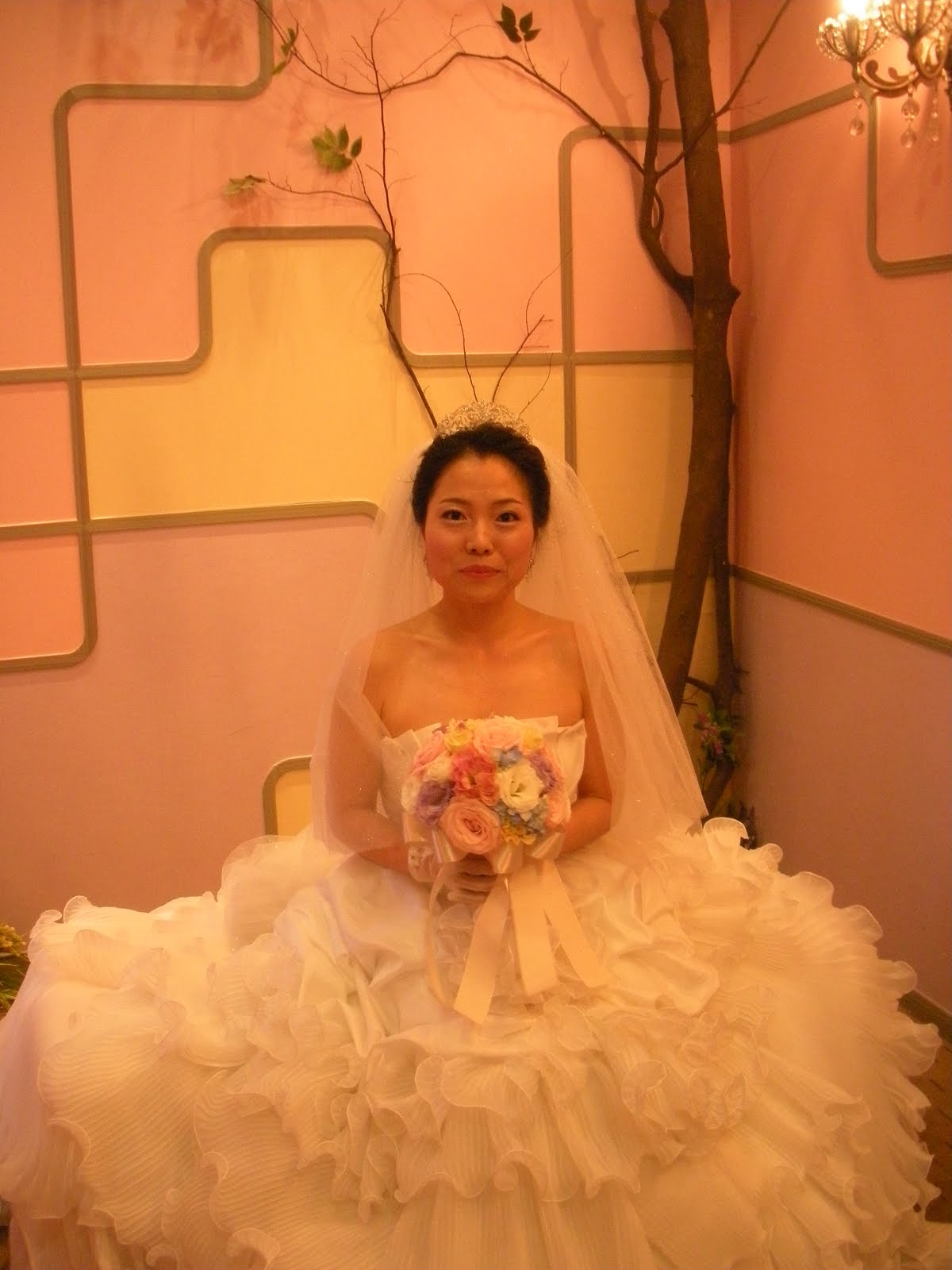 Ahn yung, wife-to-be, Ms. Kim.
The wedding took place in a giant, multi-storied building where like 10 weddings seemed to be going on at the same time. There's a real assembly-line approach to tying the knot. Leading up to the ceremony, they make the bride sit alone in a little room where she smiles til' her face hurts, depicted above. It was a little awkward to take pictures with her perched on a little cushion consumed by her giant plume of a dress.
Soon after, we made our way into the hall.
 I was feeling artistic with the black and white. I'm no photographer.
 The groom! Note the woman standing in front of him. There were a bunch of them running around dressed either like flight attendants or secret service and they all had earpieces and mics to orchestrate the big show.
 A lovely exchange of the rings. It was impossible to get a picture without the photographer in the way. He stood directly in front of the bride and groom through half the ceremony.
The man presiding over the affair finished his remarks and they built a champagne waterfall for a toast. Afterward, a friend went up and sang a famous Korean karaoke number from the side aisle while they stood from the altar watching. With the flight attendant secret service agents rushing everything along, the whole wedding was over in under 20 minutes, I assume because another wedding party was waiting to use the space. Amazing!
All told, I haven't been to many weddings back in the west, but this one was certainly different and memorable.
 Later on, I was downtown with some of the other teachers from my school and I got a picture with one of the giant costumed characters that try to attract people into the make-up stores. Woo Asian character advertisement!
PICNIC FISHIN'
Mr. Lee invited me on a picnic with his family and friends in Cheong-do, a town 40 minutes outside of Daegu. I took some pictures, so why not attach it to the wedding post?
 Mr. Lee's oldest son Jae-Min (pronounced jay-meen) in the car on our way. Jae-Min is one of my newest phonics students and we have blast drawing pictures of dragons, firetrucks, and sharks. He can spell "banana" with the best of them.
 We set up on a little parking space along a peaceful river. Out came the grill, steak, beer, soju, and of course, kimchi. The grilling was delicious and the company friendly. His friends were very nice and I enjoyed playing with the kids.
 I did my best to make sure the boys behaved themselves with the rods.
 With the rods not working out too well, we tried to use nets to catch fish. Mr. Lee with his shorts rolled up in the distance. It was an interesting net rig: two bamboo sticks with net strung in between and weights attached along the bottom. I managed to catch a few with it:
 I was the only one that had success, so Mr. Lee told me I should change my job. Jokingly, right?
 Jae-Yoon and I. Jae-Yoon is his second son, and you may notice a pattern. His third son's name is Jae-Soon. Commonly, Korean boy siblings are given names with the same first syllable. For example, I have a few sets of brothers for students: Wan-Ook and Wan-Joon; Hong-Woo and Hong-Ook; Dong-Chan and Dong-Chul.
They've recently flooded the rice paddies across Korea. It made for a pleasant picture from the car.
 See Peckrill's blog for a bit about rice planting. He actually participated...I'm jealous.
Sunday, June 13, 2010

Blue Sky Church
Joseph picked me up around 5:00 on a Sunday. Together we drove to Blue Sky, his church, about 5 minutes from my school.
We made our way up the stairs into the "church" hall (standalone church buildings are virtually unknown here; due to lack of space, most are single floors in a larger building, thus you have doctor clinics, restaurants, churches, and small academies like my school sharing space) where I was greeted by many smiling faces.
I did my best to shake hands, bow, and say "ahn-yung-ha-sae-yo" to everyone, but honestly it's never not awkward. They often ask me questions in Korean or make comments and all I have in my arsenal of vocabulary is "hello," "thank you," and "yes." Koreans use "yes" much more. When you say thanks or goodbye, the most common response is just nae! "yes."
I really wonder what they make of me, because if you flip it around and imagine some foreign guy in the US that can only smile and say "yes" in response to anything you say it's both really funny and really sad.
I hadn't been there for more than a minute before someone told me I was handsome. I'm not letting it go to my over-sized head. It's pure fascination with westerners I think. I've even had taxi drivers take a good long look at me in the rear-view, gesture "face" and then give the thumbs up. I'm told that Koreans think their noses are too flat and they really admire larger noses. You see, the Leech hawk nose as mother has affectionately called it has it's place in the world.
After the 15th person told me I was handsome, things got underway.
I should do better to explain. Joseph (I call him by his English name) is one of the new teachers that just started at my school. We went through a bit of crisis a few months ago when one teacher got pregnant, one got engaged, and another booked a ticket to live abroad and they all put in their notice to quit within the span of a week or two.
A few weeks ago, he invited me to his home for lunch on one of our days off. At the recommendation of Mr. Lee (he's great for giving pointers on correct cultural politeness) I brought a gift. His wife recently got pregnant, so I went to the baby shop across the street and got a mobile. It was pretty adorable.
Joseph is one of the happiest, friendliest Koreans I've met here. He talks to me in English and uses English around me whenever possible (even addressing other Korean teachers), which I was not really used to at first. To be honest, I had my doubts and actually wondered if he was full of it. Luckily he's not, and at lunch, he asked if I would attend a special church event where members were asked to bring and introduce a friend that doesn't go to church. I didn't want to offend him and turn down the invitation, and I also jump at any chance to meet more people and gain some insights into what has become a big part of this society.
As is often the case when I'm invited by a Korean friend somewhere, I was the only foreigner. The church was very casual and laid-back, very different from the formality and ritual of a Catholic service. The preacher was a woman and though she had a sport coat on, I definitely saw pink slippers on her feet behind the podium. There were breaks in between things where everyone was just encouraged to chat up their neighbor. There was a choreographed dance (of course, right), a few pianos performances, and a few singers. All music was geared towards love of God, and Joseph translated lyrics for me in snippets.
There was no reading from the scripture. Instead, the lights suddenly went down and we watched a movie. It was a little bizarre. From what Joseph was telling me, the subtext told the creation story, and the rise of good and evil, and the temptations of sin. The bizarre part was that the video was, of all things, an epic montage of Lord of the Rings clips. While Joseph was telling me stories of human nature and humans relationship with God, there were orcs, hobbits, and elves running around on the screen. I decided it best not to inquire why.
 Eventually, some clips from the Passion of the Christ slipped in. Much more theme-appropriate.
After the sermon, we shared a delicious bulgogi (spicy stir-fried meat and vegetables) and rice dinner. Kimchi, ever present, had a supporting role. At the beginning, all those who brought friends stood up to talk about their friend and introduce them. Joseph had some wonderfully touching remarks about me that he said in English. They were translated and projected on a screen behind him so the audience could understand. He gave me a copy which I will share a part of:
Dear Keith,
Welcome to our blue sky church and thank you very much for all coming this way that you were willing to accept my invitation.
We have a group of youth named "Passion" which means passion for Christ. Everyone has expected you to come to our church and we are pleased to see you now.
I am really glad to introduce you to my church family and to my God. I believe God led you here the house of God bless you to know him that how much love he has for you!
Anyway when I work with you, I think that you have warm heart and sense of humor and good manner, I feel deep affection for your life that you've been living not in your country but in Korea which has different language and culture. It's not easy to get along with foreign friends who are sometimes afraid to speak in English but you have an advantage others to come to you easily because you have good smiling and sense of humor.
As you know I also lived another country so I know you might sometimes face difficult situations coming from different culture. Above all things you may miss your people you really want to see. Your family, your girlfriend, your friends because without them it's not easy to tell something you love to talk from in your heart and in foreign country Korea it's not easy to be comfort from someone who know you very well. I did. I also sometimes got depressed to live abroad so I thought I like hometown which has the same culture and language. Keith, you're also supposed to come back to your country...
I'd really like to give thanks and glory to Our God to bring you Keith to the House of God. And God bless you in the name of Jesus.
I don't know if I'll go back, but I definitely appreciate what churches like that one do. God is important, but it really just seems to be mostly about community and having a social outlet to see other people and share talents and show love. It's good to have a friend like Joseph at work.
We made our way up the stairs into the "church" hall (standalone church buildings are virtually unknown here; due to lack of space, most are single floors in a larger building, thus you have doctor clinics, restaurants, churches, and small academies like my school sharing space) where I was greeted by many smiling faces.
I did my best to shake hands, bow, and say "ahn-yung-ha-sae-yo" to everyone, but honestly it's never not awkward. They often ask me questions in Korean or make comments and all I have in my arsenal of vocabulary is "hello," "thank you," and "yes." Koreans use "yes" much more. When you say thanks or goodbye, the most common response is just nae! "yes."
I really wonder what they make of me, because if you flip it around and imagine some foreign guy in the US that can only smile and say "yes" in response to anything you say it's both really funny and really sad.
I hadn't been there for more than a minute before someone told me I was handsome. I'm not letting it go to my over-sized head. It's pure fascination with westerners I think. I've even had taxi drivers take a good long look at me in the rear-view, gesture "face" and then give the thumbs up. I'm told that Koreans think their noses are too flat and they really admire larger noses. You see, the Leech hawk nose as mother has affectionately called it has it's place in the world.
After the 15th person told me I was handsome, things got underway.
I should do better to explain. Joseph (I call him by his English name) is one of the new teachers that just started at my school. We went through a bit of crisis a few months ago when one teacher got pregnant, one got engaged, and another booked a ticket to live abroad and they all put in their notice to quit within the span of a week or two.
A few weeks ago, he invited me to his home for lunch on one of our days off. At the recommendation of Mr. Lee (he's great for giving pointers on correct cultural politeness) I brought a gift. His wife recently got pregnant, so I went to the baby shop across the street and got a mobile. It was pretty adorable.
Joseph is one of the happiest, friendliest Koreans I've met here. He talks to me in English and uses English around me whenever possible (even addressing other Korean teachers), which I was not really used to at first. To be honest, I had my doubts and actually wondered if he was full of it. Luckily he's not, and at lunch, he asked if I would attend a special church event where members were asked to bring and introduce a friend that doesn't go to church. I didn't want to offend him and turn down the invitation, and I also jump at any chance to meet more people and gain some insights into what has become a big part of this society.
As is often the case when I'm invited by a Korean friend somewhere, I was the only foreigner. The church was very casual and laid-back, very different from the formality and ritual of a Catholic service. The preacher was a woman and though she had a sport coat on, I definitely saw pink slippers on her feet behind the podium. There were breaks in between things where everyone was just encouraged to chat up their neighbor. There was a choreographed dance (of course, right), a few pianos performances, and a few singers. All music was geared towards love of God, and Joseph translated lyrics for me in snippets.
There was no reading from the scripture. Instead, the lights suddenly went down and we watched a movie. It was a little bizarre. From what Joseph was telling me, the subtext told the creation story, and the rise of good and evil, and the temptations of sin. The bizarre part was that the video was, of all things, an epic montage of Lord of the Rings clips. While Joseph was telling me stories of human nature and humans relationship with God, there were orcs, hobbits, and elves running around on the screen. I decided it best not to inquire why.
Eventually, some clips from the Passion of the Christ slipped in. Much more theme-appropriate.After the sermon, we shared a delicious bulgogi (spicy stir-fried meat and vegetables) and rice dinner. Kimchi, ever present, had a supporting role. At the beginning, all those who brought friends stood up to talk about their friend and introduce them. Joseph had some wonderfully touching remarks about me that he said in English. They were translated and projected on a screen behind him so the audience could understand. He gave me a copy which I will share a part of:
Dear Keith,
Welcome to our blue sky church and thank you very much for all coming this way that you were willing to accept my invitation.
We have a group of youth named "Passion" which means passion for Christ. Everyone has expected you to come to our church and we are pleased to see you now.
I am really glad to introduce you to my church family and to my God. I believe God led you here the house of God bless you to know him that how much love he has for you!
Anyway when I work with you, I think that you have warm heart and sense of humor and good manner, I feel deep affection for your life that you've been living not in your country but in Korea which has different language and culture. It's not easy to get along with foreign friends who are sometimes afraid to speak in English but you have an advantage others to come to you easily because you have good smiling and sense of humor.
As you know I also lived another country so I know you might sometimes face difficult situations coming from different culture. Above all things you may miss your people you really want to see. Your family, your girlfriend, your friends because without them it's not easy to tell something you love to talk from in your heart and in foreign country Korea it's not easy to be comfort from someone who know you very well. I did. I also sometimes got depressed to live abroad so I thought I like hometown which has the same culture and language. Keith, you're also supposed to come back to your country...
I'd really like to give thanks and glory to Our God to bring you Keith to the House of God. And God bless you in the name of Jesus.
I don't know if I'll go back, but I definitely appreciate what churches like that one do. God is important, but it really just seems to be mostly about community and having a social outlet to see other people and share talents and show love. It's good to have a friend like Joseph at work.
Thursday, May 27, 2010
Korean Politics
Politicking fever has spread across the whole of the Korean peninsula in anticipation of local and provincial elections. If you expect simple public canvassing and advertisement, remember, this is Korea.
The little blue pickup trucks you normally see selling produce on the side of road have been plastered with portraits, slogans, and packed with women wearing white gloves that, backed by K-synth beats, perform synchronized hand dances while singing songs about their candidate. I've also heard remixes of "If you're happy and you know it," "Yankee Doodle," and something that sounded like the "Hokey Pokey,"that replace those ever-so-familiar lyrics with catchy slogans and the candidate's name.
That, ladies and gentlemen, is how you get the vote out.
A few weeks ago, Mr. Lee invited me to the opening ceremony for a campaign in Goryeong, a town in the province to the north of Daegu. The candidate, Jeong Jae Soo, is the father of Mr. Lee's friend, Mr. Jeong. He works at my bank and I went to the driving range with them once.
The event was held at the headquarters. Loads of people showed up, and you could barely move inside. It should be noted that there was free food.
 Feeling lonely in sea of Korean dudes...
 A modest portrait on the front of the building, complimented by another modest portrait on the side. With a second look, I decided his pose is Fonz-esque: "ay, come on, vote for me, why not, ay!"
 Friends and allies gave these flower arrangements as congratulatory gifts. The larger the display, the larger the expected influence? All the Korean guys, presumably business associates, standing around smoking cast an "organized" air over everything if you catch my drift.
A professional entertainment company MC'd the whole shebang and the woman on the mic would periodically shout things to applause. I made a habit of joining the applause. Mr. Lee thought this was really funny, and because I had no idea what I was clapping for it kinda was.
 Shortly before we left, the elder Mr. Jeong made the rounds. I got a picture with him. Once we posed, three other professional photographers appeared to snap pictures. I can see the Korean Glen Beck now:
"Jeong is clearly in the back pocket of sneaky Western influences! Unpatriotic trickery, I say! You know, HITLER was from the West!"
I'm pretty used to loud disturbances from the street below my school, but these campaigns have topped all. In the middle of the busy intersection, candidates have been giving introductory speeches. The guy in the video was so loud it sounded like he was in my classroom even from around the corner and four stories up. I was ready to stick my head out the window and give a shake of the fist. Some people stopped to listen, but for the most part everyone just went about their business.
"So glad this soapbox came with a BLASTING P.A.!" Oh yeah, lime green. Totally your color.
Onward marches the parade of democracy!
The little blue pickup trucks you normally see selling produce on the side of road have been plastered with portraits, slogans, and packed with women wearing white gloves that, backed by K-synth beats, perform synchronized hand dances while singing songs about their candidate. I've also heard remixes of "If you're happy and you know it," "Yankee Doodle," and something that sounded like the "Hokey Pokey,"that replace those ever-so-familiar lyrics with catchy slogans and the candidate's name.
That, ladies and gentlemen, is how you get the vote out.
A few weeks ago, Mr. Lee invited me to the opening ceremony for a campaign in Goryeong, a town in the province to the north of Daegu. The candidate, Jeong Jae Soo, is the father of Mr. Lee's friend, Mr. Jeong. He works at my bank and I went to the driving range with them once.
The event was held at the headquarters. Loads of people showed up, and you could barely move inside. It should be noted that there was free food.
 Feeling lonely in sea of Korean dudes...
 A modest portrait on the front of the building, complimented by another modest portrait on the side. With a second look, I decided his pose is Fonz-esque: "ay, come on, vote for me, why not, ay!"
 Friends and allies gave these flower arrangements as congratulatory gifts. The larger the display, the larger the expected influence? All the Korean guys, presumably business associates, standing around smoking cast an "organized" air over everything if you catch my drift.
A professional entertainment company MC'd the whole shebang and the woman on the mic would periodically shout things to applause. I made a habit of joining the applause. Mr. Lee thought this was really funny, and because I had no idea what I was clapping for it kinda was.
 Shortly before we left, the elder Mr. Jeong made the rounds. I got a picture with him. Once we posed, three other professional photographers appeared to snap pictures. I can see the Korean Glen Beck now:
"Jeong is clearly in the back pocket of sneaky Western influences! Unpatriotic trickery, I say! You know, HITLER was from the West!"
I'm pretty used to loud disturbances from the street below my school, but these campaigns have topped all. In the middle of the busy intersection, candidates have been giving introductory speeches. The guy in the video was so loud it sounded like he was in my classroom even from around the corner and four stories up. I was ready to stick my head out the window and give a shake of the fist. Some people stopped to listen, but for the most part everyone just went about their business.
"So glad this soapbox came with a BLASTING P.A.!" Oh yeah, lime green. Totally your color.
Onward marches the parade of democracy!
Monday, May 24, 2010
A Walk in the Backyard
You may recall from the picture I posted of the mountain range behind my apartment. My neighborhood, Dowon-dong, lies on the southwestern outskirts of Daegu. Beyond, you'll only find peaceful mountains and farmed countryside.
On a sunny Sunday afternoon, a leisurely stroll up the mountain trail turned into a 4.5 hour hike over the entire range to the neighboring district on the other side. It sounds like a haul, but I saw loads of grandpas and grandmas out there. It's the diet of kimchi and daily/weekly hikes that has Koreans healthy as ever.
Thinking there would be some worthy landscapes I brought my camera along. I sure am glad I did.
 This is one of the first views on the mountain nearest my apartment. It only takes about 20 or so minutes to get from my door to here. You can pretty much see all of Daegu. Figuring prominently are the high rises, all of which are apartments. 99% of Koreans live in high rises that are 20+ stories. That stat was not at all factually based, but it seems to be the case. My students often ask about my home in America, and are both shocked and full of envy to hear that I live in a house with two stories that is physically separate from my neighbors and that there is a yard with grass and trees.
 If you imagine the mountain range as a big "U," I'm near the middle of the bottom here.
 Cheong-ryong-san, 2.5km; Ap-san, 8km; Yong-yeong-sa, 3.7km; Bee-seul-san, 9km; Sam-peel-bong, 1.6km.
 This being Korea, you would find an arrow drawn in the dirt leading you down the correct path away from the false side path. Splendid.
 The nearest mountain range on the other side is where a came from. I've now made it to the right side of the lower part of the "U."
 A look back at where I came from.
 I soon made it to the summit of Ap-san, the highest peak in the area at over 700 meters. A Korean family I met took the picture for me.
 A look back at where I came from, and a landscape that you can pretty much find Korea-wide.
 Here, you can see the reservoir at the base of the range. I basically started from where the base of the mountain meets the water on the far side. It looks way far away, and it was.
 Hazy mountain tops.
 I slowly made my way down from Apsan hoping I wouldn't end up in a town outside of Daegu. One wrong path could have taken me there, but I was careful to stay oriented. Near the bottom of Ap-san, I came to a much needed spring water station. Wow, was it refreshing.
 I had a nice chuckle soon after compliments of the distressed drowning boy illustration. It's troubling how disproportional his right eyebrow is. Really.
"Su-yeong-geum-jee." From context, we can guess it means "NO SWIMMING." See, Korean isn't that hard, is it?
On a sunny Sunday afternoon, a leisurely stroll up the mountain trail turned into a 4.5 hour hike over the entire range to the neighboring district on the other side. It sounds like a haul, but I saw loads of grandpas and grandmas out there. It's the diet of kimchi and daily/weekly hikes that has Koreans healthy as ever.
Thinking there would be some worthy landscapes I brought my camera along. I sure am glad I did.
 This is one of the first views on the mountain nearest my apartment. It only takes about 20 or so minutes to get from my door to here. You can pretty much see all of Daegu. Figuring prominently are the high rises, all of which are apartments. 99% of Koreans live in high rises that are 20+ stories. That stat was not at all factually based, but it seems to be the case. My students often ask about my home in America, and are both shocked and full of envy to hear that I live in a house with two stories that is physically separate from my neighbors and that there is a yard with grass and trees.
 If you imagine the mountain range as a big "U," I'm near the middle of the bottom here.
 Cheong-ryong-san, 2.5km; Ap-san, 8km; Yong-yeong-sa, 3.7km; Bee-seul-san, 9km; Sam-peel-bong, 1.6km.
 This being Korea, you would find an arrow drawn in the dirt leading you down the correct path away from the false side path. Splendid.
 The nearest mountain range on the other side is where a came from. I've now made it to the right side of the lower part of the "U."
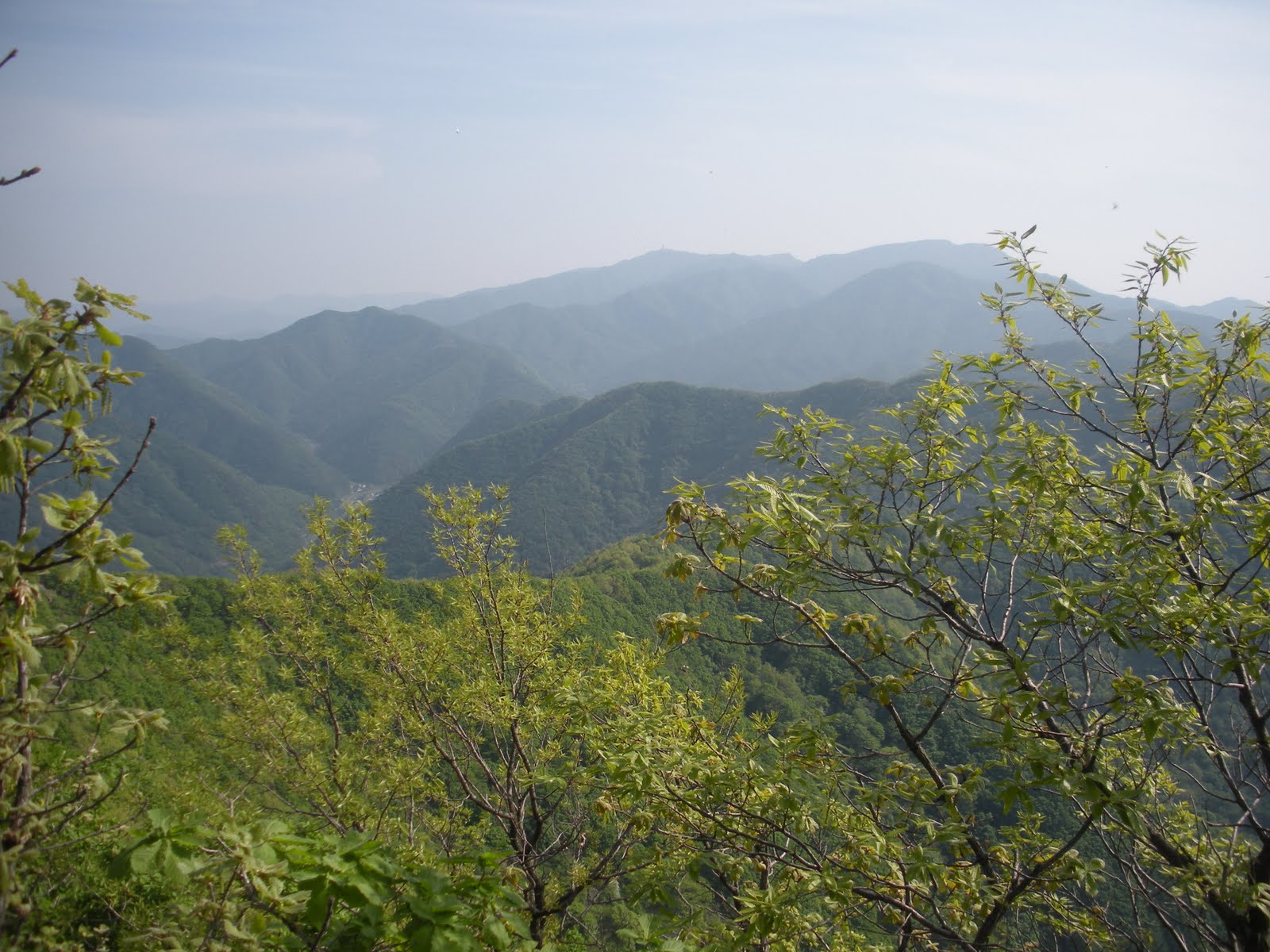 A look back at where I came from.
 I soon made it to the summit of Ap-san, the highest peak in the area at over 700 meters. A Korean family I met took the picture for me.
 A look back at where I came from, and a landscape that you can pretty much find Korea-wide.
 Here, you can see the reservoir at the base of the range. I basically started from where the base of the mountain meets the water on the far side. It looks way far away, and it was.
 Hazy mountain tops.
 I slowly made my way down from Apsan hoping I wouldn't end up in a town outside of Daegu. One wrong path could have taken me there, but I was careful to stay oriented. Near the bottom of Ap-san, I came to a much needed spring water station. Wow, was it refreshing.
 I had a nice chuckle soon after compliments of the distressed drowning boy illustration. It's troubling how disproportional his right eyebrow is. Really.
"Su-yeong-geum-jee." From context, we can guess it means "NO SWIMMING." See, Korean isn't that hard, is it?
Subscribe to:
Posts (Atom)